In many of our discussions with commercial, engineering, wholesale, and industrial clients, we notice that the question “Are all LED light products dimmable?” comes up frequently. Based on our manufacturing experience, dimming capability depends on the structural design of the light source, the power-control method, and the driver configuration. At Aiyu, we always advise customers to review these points before confirming large orders. By understanding the intended environment and required brightness range, we help customers avoid mismatches that may lead to flicker or uneven dimming. Since we operate as an OEM and ODM provider, our evaluation process supports clients who need stable lighting performance for long-term operational needs.
Requirements for Reliable Dimming Performance
Before confirming whether a model can be dimmed smoothly, our team examines the behavior of the driver system. Not every LED light driver supports brightness variation, especially when the circuit uses a simple constant-voltage layout without dimming functions. We maintain a structured test routine to check brightness stability, color consistency, and compatibility with external control systems. Our product certifications—including CE, ROHS, BIS, ETL, CQC, FCC, CB, LVD, and EMC—together with ISO9001, ISO14001, and ISO45001 management systems, help ensure that the configurations our customers choose meet industry expectations. We also keep 24-hour online service available so buyers can clarify technical questions in real time during wholesale and customization planning.
Application Reference Using Model AY5050-60D-24V-10MM
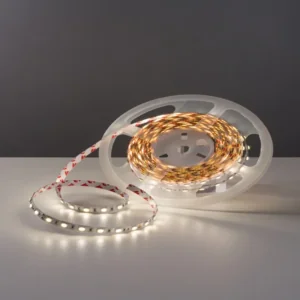
When customers evaluate dimming needs, we also introduce how our strip-light model AY5050-60D-24V-10MM performs in different scenarios. This product uses a 5050 light source with 60 LEDs per meter and a 10MM PCB width, supplied in 5M rolls. It runs on DC24V and can be selected in IP20, IP44, IP65, or IP68 depending on project requirements. Color-temperature options include 3000K, 4000K, and 6500K, allowing flexibility for industrial, commercial, and interior environments. For clients who request dimming for this model, we help confirm the appropriate driver pairing and check whether the installation site requires precise, low-step brightness transitions. Rather than assuming universal dimming capability, our role is to make sure the final configuration matches the technical conditions needed for stable operation.
Conclusion
Not every LED light is designed for dimming, and the correct selection depends on the interaction between the light source, driver, and intended application. At Aiyu, we provide practical guidance, testing support, and OEM/ODM solutions that help our customers adopt reliable lighting structures for commercial, engineering, or industrial projects. By reviewing specifications carefully and confirming compatibility in advance, we help buyers move forward with confidence and achieve consistent dimming performance across large-scale installations.