Designing an ultra-long LED strip installation is not simply a matter of selecting brighter products or connecting more strips together. Large commercial projects often require continuous lighting lines that extend across ceilings, walls, retail structures, or architectural features, making electrical stability a major design challenge.
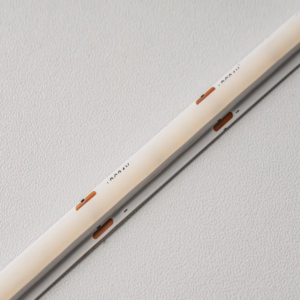
The decision between 24V and 48V systems becomes especially important in these situations. At the same time, choosing between constant voltage and constant current technology can influence how effectively a lighting system maintains consistent output over distance.
A short decorative installation may perform well with a standard setup, but large-scale commercial projects require a more carefully planned approach. As a professional LED lighting manufacturer, we focus on helping customers evaluate the complete system design rather than selecting components individually.
Why Ultra-Long LED Strip Runs Require a Different Electrical Strategy
Long LED strip installations face challenges that are less noticeable in small projects. The further electrical power travels through a circuit, the more resistance affects the available voltage and current reaching the LEDs.
This effect can create uneven illumination. The beginning of a long strip may appear brighter than the far end, reducing the visual quality of architectural lines or commercial displays. For premium environments, even small differences in brightness can affect the final design result.
Daisy-chained configurations increase the importance of electrical planning because multiple connected sections share the same power source. The system must distribute energy effectively while preventing excessive current demand across individual sections.
The solution is not always to increase the voltage. Designers must consider the relationship between strip construction, driver technology, cable length, installation method, and required lighting performance.
Commercial projects using LED strip lighting often require a balance between installation simplicity and long-term reliability. This is why voltage selection and current management should be considered during the initial design stage rather than after installation problems appear.
Comparing 24V and 48V Through the Lens of Power Transmission
The main difference between 24V and 48V systems is how they handle electrical current during power delivery. For the same power output, a higher voltage system generally requires less current. Lower current can help reduce energy losses along longer cable distances.
A 24V system remains a widely used solution because it offers broad compatibility with drivers, controllers, and installation accessories. It is often suitable for commercial applications where strip lengths are moderate and power injection points are available.
However, ultra-long installations introduce additional challenges. A 24V system may require more frequent power feeding points to maintain consistent illumination across extended distances. Without proper planning, additional wiring requirements can increase installation complexity.
A 48V system approaches the same challenge differently. By operating at a higher voltage, it can reduce current requirements for equivalent power levels, which can make it more suitable for longer runs where minimizing voltage loss is a priority.
The choice between 24V and 48V should therefore be based on project scale. A small retail display and a large architectural ceiling installation may have completely different electrical requirements, even if both use LED strips as the light source.
At Aiyu, we evaluate these factors during product development and project discussions to help customers match their lighting goals with suitable system configurations.
Constant Voltage vs. Constant Current: Two Different Ways to Control LED Performance
Voltage level is only one part of the equation. The control method behind the LEDs also affects system behavior. Constant voltage and constant current designs manage power delivery in different ways.
Constant voltage systems maintain a fixed voltage output while the LED strip regulates current through its internal design. This approach is common because it provides flexibility when connecting multiple lighting components and controllers.
For many commercial applications, constant voltage systems offer a practical balance between cost, availability, and installation convenience. They work effectively when the system length and power distribution are properly calculated.
Constant current systems focus on maintaining a stable current supply to the LEDs. This can help improve consistency in applications where maintaining uniform brightness over long distances is a primary requirement.
However, constant current systems usually require more specialized matching between drivers and LED components. The design process becomes more technical because the power supply and lighting modules must operate together as a coordinated system.
Neither approach is automatically superior. The better choice depends on whether the project prioritizes simplified installation, long-distance consistency, reduced wiring complexity, or precise electrical control.
Selecting the System Architecture Behind Reliable Large-Scale Lighting Projects
For ultra-long commercial installations, the selection process should begin with the physical layout rather than the product catalog. Designers need to understand the total lighting length, available power locations, expected brightness, and maintenance requirements.
A 24V constant voltage system may be appropriate when flexibility and compatibility are important, especially for projects with manageable distances and accessible power points. It can provide an efficient solution without unnecessary system complexity.
A 48V or constant current architecture may become more attractive when the project requires longer continuous runs, fewer connection points, or improved brightness consistency across large areas.
The role of the supplier is also important. A capable LED lighting manufacturer should provide technical support beyond supplying LED strips. Understanding circuit design, product selection, and installation conditions helps prevent performance issues after deployment.
We work with commercial lighting partners to develop solutions that consider both product performance and project requirements. Our experience with LED strip lighting allows us to support different installation environments, from architectural features to large commercial applications.
For businesses planning demanding lighting projects, choosing the correct electrical architecture can determine whether the final installation achieves professional results. At Aiyu, we provide manufacturing expertise and customized LED solutions to help customers create stable, scalable lighting systems.
Conclusion
The choice between 24V and 48V LED strip systems is not simply a voltage comparison; it is a decision about how efficiently a lighting system can deliver consistent performance across long distances.
Constant-voltage systems remain practical for many commercial applications. Higher-voltage or constant-current approaches may be considered for more complex long-distance installations. We evaluate installation distance, power distribution, and project requirements together to help partners select suitable LED strip solutions.